The french women had felt the painting they saw and they produced several masterpieces, too. Let us talk about some of the prolific women painters. It is said that the paintings are to be seen and not to be talked about. But we are to talk about the paintings done by the women artists.
Let us start talking about the women artist of France. Woman artists of France, who lived in the eighteenth century. Let us start. Let us start with some of the renowned portrait-makers women artists.
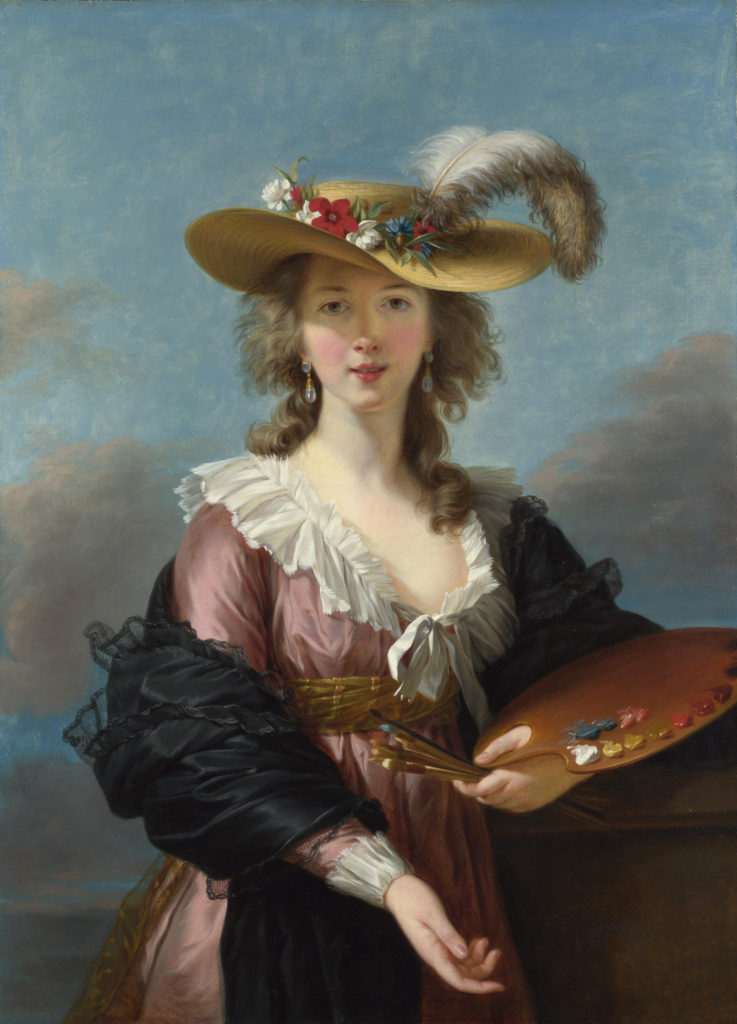
Self Portrait in a Straw Hat
Élisabeth Louise Vigée Le Brun
Oil on Canvas,
National Gallery, Central London
Élisabeth Louise Vigée Lee Brun (1755-1842):
She was known as Madame Lee Brun, among the artists and her friends. She started her painting career early, in her teenage. But what deed she painted? she painted beautiful flowers. She painted beautiful people.
Yes, she had painted more than 600 portraits. The landscape was her favourite subjects. She had a collection of 200 landscapes. Presently, her paintings are displayed in major museums of the world.
Look at the portrait of Mohammed Dervish Khan. This painting was sold for $7.2 Million at Sotheby, in the year 2019. This sale of the portrait by Élisabeth Louise Vigée Le Brun has set a world record for a woman artists who lived before 1900.
Elisabeth had the opportunity to travel to the Netherlands, with her husband. There she observed the paintings of Flemish master artists. The Self-Portrait with Straw Hat (1782) given at the top is by Elisabeth. For this portrait, we can see that she would have got inspiration from the work of Peter Paul Ruben.
The State Hermitage Museum, Saint Petersburg, Russia; National Gallery, Central London; Metropolitan Museum of Art, New York City: these are the museums that have displayed the paintings of Madama Lee Burn. There were contemporary artists, too, who had painted portraits in the style and poses Elisabeth had done.
Look at the self-portrait of one contemporary woman artist of France, Adélaïde Labille-Guiard (1749 – 1803). We can see the influence of Elisabeth’s painting given above, in Adélaïde Labille-Guiard’s self-portrait.
Adélaïde was a wonderful artist on her own. She had painted a number of portraits and miniature portraits, too. After the French revolution, the paintings of women were also allowed to be displayed their work freely.
Adélaïde’s works had been also displayed in several exhibitions and museums. in Salon. Marie had displayed her paintings in Salon, too.
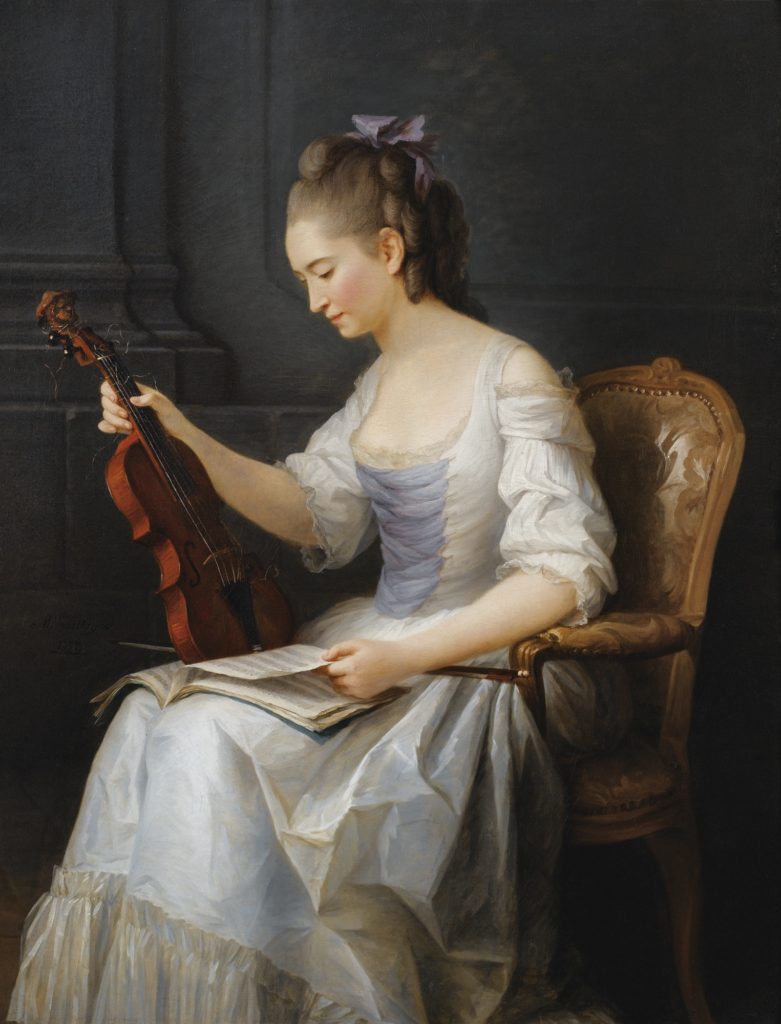
Painting of a female violinist
Anne Vallayer-Coster
Oil on canvas National Museum of
Fine Arts, Stockholm, Sweden
Anne Vallayer-Coster:
There was a river Bievre, near the river Seine. There was the home of a goldsmith. He had a golden connection with the royal family of France. Anne was born in 1744 as one of the four daughters of the said Goldsmith. Her father had a business of tapestry. Her artwork had found a way onto the tapestries produced in her father’s factory.
In eighteenth-century France, portrait painting and still-life paintings were not considered first-grade art. However, Anne accepted the challenge and created marvellous portraits. Once her family moved to Paris, her portraits and other still-life were in good demand.
Anne had friends in Royal families. But once the royal family was on the decline of its influence, Anne had suffered a setback, too. It was the days that the women were subjected to several restrictions. Art institutions were not allowing women to learn art, too. The display of the painting in a gallery was a rare event.
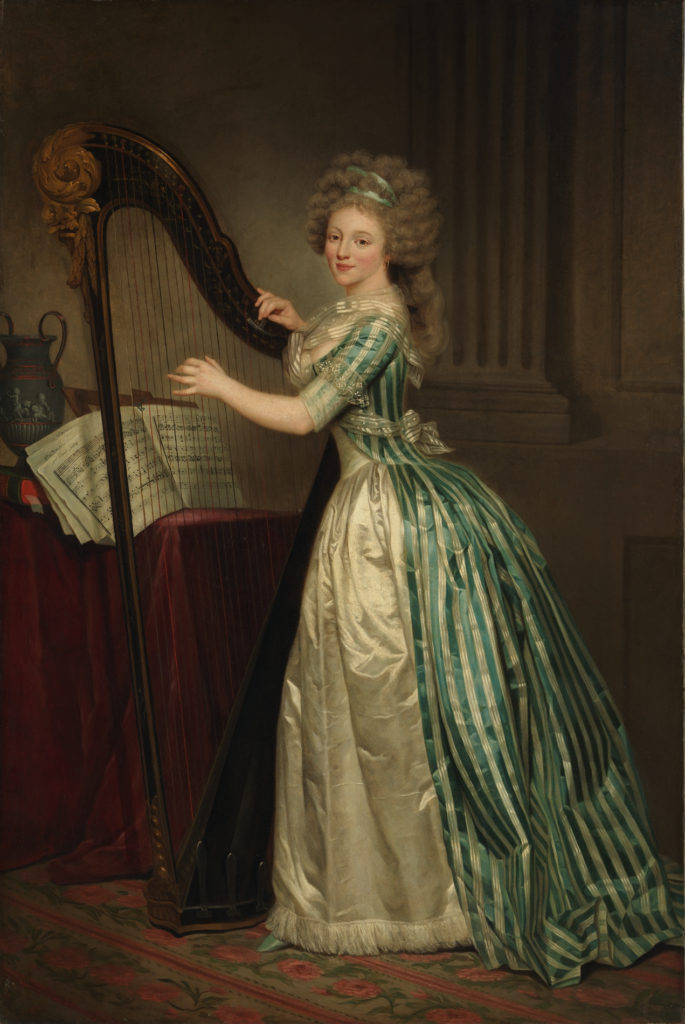
Self-portrait with a Harp
Oil on Canvas Rose-Adélaïde Ducreux
Metropolitan Museum of Art of New York City
Rose-Adélaïde Ducreux (1761-1802):
She was a French painter. She was a musician, too. She was born in Paris at the time of the French revolution. It was the brightest of the times in France; It was the darkest of the times in France. However, the French women and men artists kept the bell of painting ringing. Rose was one of them.
The self-portrait shown here is painted using oil on canvas. However Rose used paster colours very artistically. Here in this self-portrait, the artist is depicted along with her musical instruments. Rose had used such a colour scheme in her paintings that the viewers would find them very light and gentle to the eye.
Rose had made her debut at the Louvre Salon. It was the year 1791 when Rose had submitted this portrait Self-portrait with a Harp, wherein she was playing the harp. This painting is presently displayed in the Metropolitan Museum of Art, New York City, USA. [All the images are in Public Domain, taken from Wikimedia Commons]
Courtesy: www.paintingsgalleries.com
]]>Degas began by copying Italian Renaissance paintings at the Louvre and trained in the studio of Louis Lamothe, who taught in the traditional academic style, with its emphasis on line and its insistence on the crucial importance of draftsmanship. Degas was also strongly influenced by the paintings and frescoes he saw during several long trips to Italy in the late 1850s; he made many sketches and drawings of them in his notebooks.
Evidence of Degas’ classical education can be seen in his relatively static, friezelike early painting, Young Spartans Exercising (ca. 1860; National Gallery, London), done while he was still in his twenties. Yet despite the title, and the suggestion of classical drapery on some of the figures in the background, there is little that places the subject of this painting in ancient Greece. Indeed, it has been noted that the young girls have the snub noses and immature bodies of “Montmartre types,” the forerunners of the dancers Degas painted so often throughout his career. After 1865, when the Salon accepted his history painting The Misfortunes of the City of Orléans (Musée d’Orsay, Paris), Degas did not paint academic subjects again, focusing his attention on scenes of modern life. He began to paint scenes of such urban leisure activities as horse racing and, after about 1870, of café-concert singers and ballet dancers.
]]>At the age of 40, Sir Winston Churchill found himself at a career low: After the World War I attack he ordered on Gallipoli, Turkey, went horrifically awry, he was demoted from his role as First Lord of the Admiralty in May 1915. He resigned from his government post and became an officer in the army. Deflated of power and consumed with anxiety, he took up an unexpected new hobby: painting.
“Painting came to my rescue in a most trying time,” Churchill would later write in the 1920s, in essays that would become a small book, Painting as a Pastime. The hobby became, for the great British statesman, a source of delight and a respite from the stress of his career. He would eventually create over 550 paintings, crediting the practice with helping him to hone his visual acuity, powers of observation, and memory. The pastime would flourish, and perhaps even aid him, as he furthered his career as a world-renowned writer, orator, and political leader.
Churchill first picked up a brush at the suggestion of his sister-in-law, Lady Gwendoline Bertie, who was also a painter. In Painting as a Pastime, he recalled his first artmaking attempt one day in the countryside. Intimidated by the blank canvas before him, he diffidently placed a pale blue daub of paint on its surface to begin the sky, and was soon interrupted by the arrival of Glasgow painter Sir John Lavery and his wife, Hazel. The latter exclaimed, “Painting! But what are you hesitating about?” She grabbed a brush and made “large, fierce strokes and slashes of blue on the absolutely cowering canvas.” With that, Churchill wrote, “I seized the largest brush and fell upon my victim with Berserk fury. I have never felt any awe of a canvas since.”
In the five decades that followed, Churchill was prolific, primarily focusing on landscapes and seascapes made en plein air. And despite his incessant claims that he was merely an amateur, he developed an admirable flair for the art.
“His approach was very simple: Go outside and paint what you see,” Duncan Sandys, Churchill’s great-grandson, told Artsy. “He did it for fun; he didn’t take his paintings very seriously.”
Churchill was most fond of oils, for their forgiving, flexible nature and bright colors—as well as the joy they exuded. “Just to paint is great fun,” he wrote. “The colours are lovely to look at and delicious to squeeze out.”
He was known to set up his easel outdoors to capture the grounds of his country home in Kent, called Chartwell. (Now owned by the National Trust and open to visitors today, it still houses Churchill’s preserved painting studio.) The politician-painter would also work during his travels to Egypt, Italy, Morocco, and the south of France, among other locations.
While a proclivity for outdoor subjects prevailed, he also tried his hand at still lifes and portraits, with varying degrees of success. Churchill’s works read as somewhat intimate snapshots, illustrating his favored travel destinations, holidays, and family members. On the whole, his subjects appear decidedly positive, communicating the pleasure he got out of depicting them.
Churchill was largely self-taught, and adamant that formal art lessons were a young person’s game. The thing he and his like-minded amateur peers needed most, he believed, was a certain kind of passion.
“We cannot aspire to masterpiece,” he wrote. “We may content ourselves with a joy ride in a paint-box. And for this Audacity is the only ticket.”
Nevertheless, he was keen to improve his technique, and did so by taking cues from leading artists. He admired the work of Impressionist and Post-Impressionist masters like Édouard Manet, Claude Monet, Paul Cézanne, and Henri Matisse, and was even known to travel to the same locations where they had painted years before, seeking out the light and land that had proven inspirational.
]]>We have all heard of the fantastic prices some pieces of art fetch at auction especially when created by some famous painter like Monet or Salvador Dali
The style of these two painters are polar opposite, however they have one very important thing in common – they both were the originators of a particular style of art.
Way back in 1860 Claude Monet was one of the first artists to paint in the “Impressionist” style, he was quickly joined by other artists who formed their own society to exhibit their artwork after being rejected by the traditional French salons, who deemed it too controversial to exhibit.
Today “Surrealism” paintings and digital art are extremely popular but did you know it was all started by Salvador Dali back in the 1920’s with some very controversial work that shocked the art world.
Just imagine if you had the good fortune and vision to buy an original painting from those artists. They both developed a new style of art that later went on to inspire other artists and art collectors world wide.
I am sure you would agree that would have been a fabulous investment.
There is an opportunity to do exactly that.
You may or may not have heard of “Prism-Equus” it is a new style of art that has been added to the urban dictionary. This unique way of painting horses was developed by artist Linda Finstad.
The definition of “Prism-Equus” is equine personality depicted in colour. The style and definition along with acknowledgment of her work has made Linda Finstad the founder of a new style of art. A style that is quickly gaining popularity and one which she is teaching to other budding artists.
A quick google images search will reveal exactly what “Prism-Equus” looks like. This style may not appeal to you or fit with your decor. The same was probably said of Pablo Picasso’s work in those early days. However when you have the opportunity to buy original art from the founder of an art movement that has to be an investment worth making. An investment that could make you rich.
If you hear a cat hissing, spitting or growling, stay away, as that indicates it is frightened or angry and might react in an aggressive manner if you get too close.
]]>